
On this page
ECS EC2 vs Fargate: Which One Is Better for AWS Workloads?

When deploying container workloads on AWS, Amazon ECS offers two primary execution models: ECS with EC2 and ECS with Fargate, each with its own cost, control, and operational implications. EC2, especially when paired with Spot Instances, can substantially reduce spend, but demands infrastructure management. Fargate simplifies operations by abstracting compute provisioning but comes at a higher cost.
Let’s evaluate these models in terms of cost efficiency, operational control, fault tolerance, and practical workload alignment.
EC2 with Capacity Providers: Lower Cost, Higher Responsibility
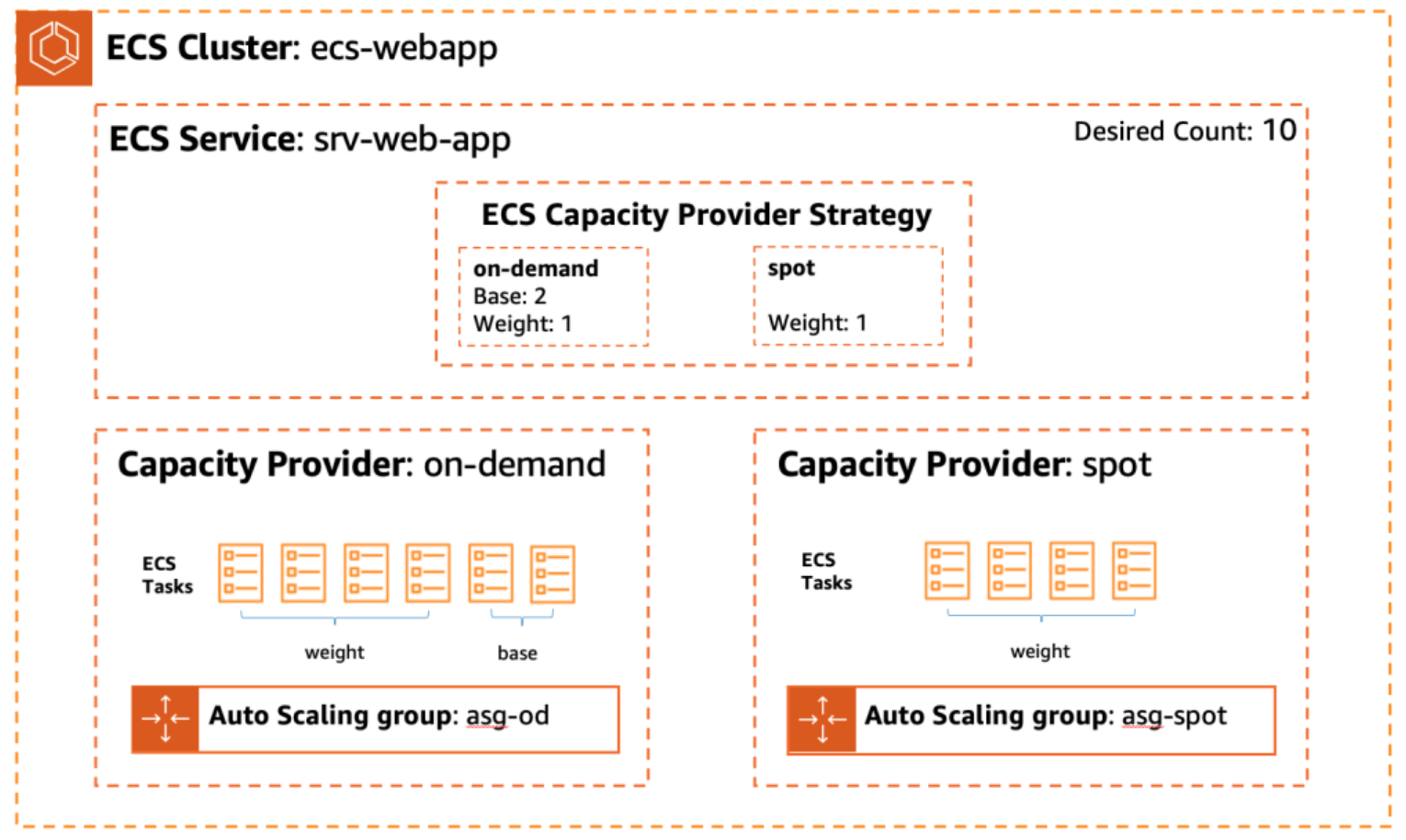
ECS on EC2 gives teams full control over compute infrastructure. Using Capacity Providers, services can be configured to intelligently balance workloads across Spot and On-Demand instances using base and weight parameters.
Advantages
- Cost Efficiency: Spot pricing reduces instance costs by up to 90%. Capacity Providers let you reserve a fixed baseline on On-Demand for reliability.
- Custom Infrastructure: Choose instance families, use GPU-enabled nodes, manage your own AMIs, and implement custom security agents.
- High Density and Control: Binpack containers for better host utilization; configure advanced placement constraints.
Operational Considerations
- Scaling Coordination: Task scaling and cluster scaling must be aligned. ECS Cluster Auto Scaling helps but isn’t zero-touch.
- Spot Disruptions: Instance reclamation events must be handled gracefully. ECS will drain and reschedule, but only if capacity is available.
- Region-Specific Availability: Spot capacity varies across instance types and availability zones. Lack of diversification can lead to launch failures.
Fargate: Operational Simplicity with Flexible Pricing
Fargate abstracts away infrastructure management by letting AWS handle compute provisioning behind the scenes. It supports two capacity providers: FARGATE (On-Demand) and FARGATE_SPOT.
Combined Operational Strategy
- Zero Infrastructure Maintenance: No instance provisioning, patching, or monitoring.
- Elastic Scaling: Tasks are launched and scaled automatically.
- Security and Isolation: Each task runs in its own compute environment.
Cost Profile
- FARGATE: Best for long-running, high-availability services where uptime is critical.
- FARGATE_SPOT: Up to 70% cheaper, ideal for CI jobs, batch processing, or non-critical tasks.
Trade-Offs
- Limited Control: No GPU support, host networking, or privileged mode.
- Fixed Resource Combinations: You must choose from predefined CPU/memory pairings.
- FARGATE_SPOT Instability: No automatic fallback; tasks can fail if capacity is not available.
Comparing the Options
| Feature | ECS EC2 + Spot | Fargate (On-Demand) | Fargate Spot |
|---|---|---|---|
| Cost | Up to 90% cheaper | Most expensive | ~70% cheaper |
| Management | High | Minimal | Minimal |
| Interruptions | Yes (requires mitigation) | No | Yes |
| Customizability | Full control | Limited | Limited |
| Startup Time | Slower (EC2 provisioning) | Faster | Faster |
| Workload Fit | Batch, GPU, dense compute | APIs, real-time services | Async jobs, dev/test |
Blending Strategies with Capacity Providers
ECS allows combining compute types using Capacity Providers. This enables workloads to be split across FARGATE, FARGATE_SPOT, and EC2-backed strategies.
Why Mix?
- Maintain reliability using a baseline of On-Demand.
- Expand elastically into Spot compute (EC2 or Fargate) to optimize cost.
- Balance resilience and spend using
baseandweightvalues.
Example: Fargate with Spot
FARGATE:       base=3, weight=1
FARGATE_SPOT:  base=0, weight=1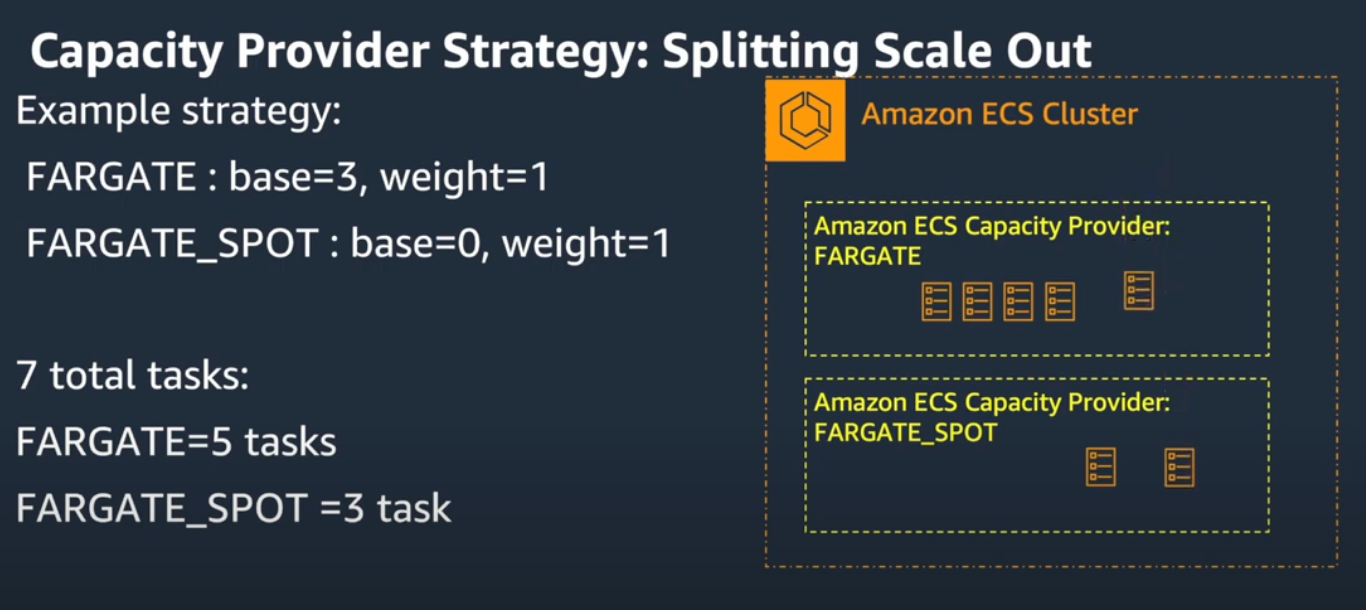
Result: Out of 7 tasks, 5 run on FARGATE and 2 on FARGATE_SPOT.
Real-World Scenario
Run 2/3 of tasks on FARGATE and 1/3 on FARGATE_SPOT
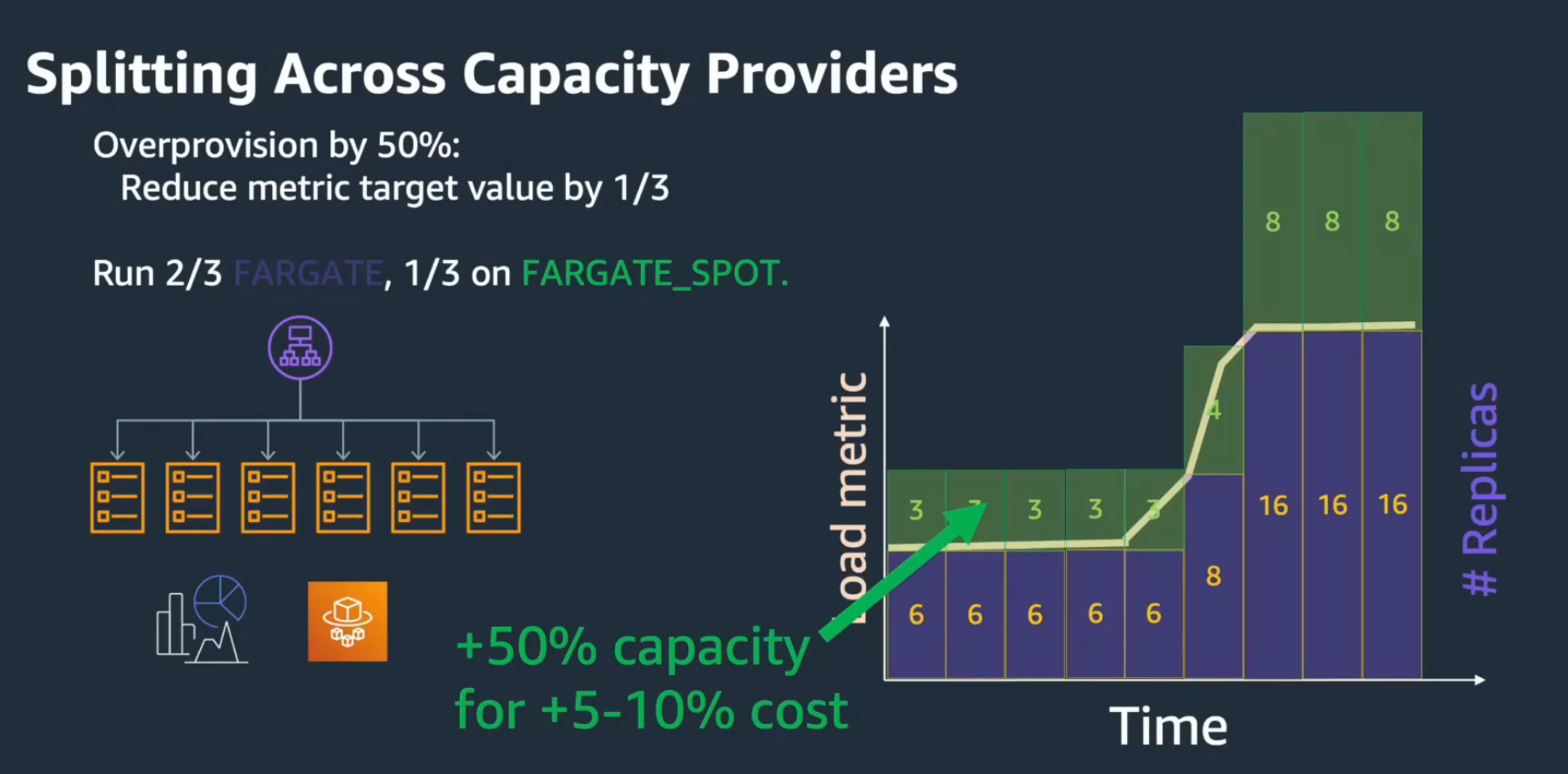
This allows 50% more capacity with only a 5–10% cost increase.
Useful for bursty workloads, horizontal scaling, or queue-based services.
FAQs
What is the difference between ECS EC2 and Fargate?
ECS EC2 gives you full control over infrastructure and lower costs, while Fargate provides serverless container management with less operational overhead.
Is AWS Fargate more expensive than ECS EC2?
Yes. AWS Fargate is usually more expensive than ECS EC2 because AWS manages the infrastructure, scaling, and operational maintenance for you.
When should I use ECS EC2 instead of Fargate?
ECS EC2 is better for long-running workloads, high-density container deployments, GPU workloads, and environments where cost optimization is important.
Does AWS Fargate support Spot pricing?
Yes. AWS Fargate supports Fargate Spot, which allows teams to reduce container costs using spare AWS compute capacity.
Which is better for production workloads: ECS EC2 or Fargate?
Both are production-ready. ECS EC2 is ideal for cost-sensitive and highly customized environments, while Fargate is better for simplified operations and faster deployments.
Final Thoughts
Fargate simplifies infrastructure. EC2 offers raw savings. Spot provides huge cost benefits—at the cost of uncertainty.
The best choice depends on:
- SLA requirements
- Team maturity in infrastructure
- Workload fault tolerance
Often, the most pragmatic solution is a hybrid capacity strategy using all three: EC2 Spot, Fargate On-Demand, and Fargate Spot.
For more insights on cost saving strategies for your Infrastructure, reach out to Kubenine.