
On this page
Stop Overpaying for GP2: GP3 Cost & Performance Explained

Introduction
Many AWS workloads still run on GP2 volumes without realizing they are paying more for lower and inconsistent performance.
GP3 volumes are cheaper, faster, and more flexible — yet many teams never migrate.
In this guide, we’ll compare GP2 vs GP3 pricing, performance, IOPS, throughput, and real-world AWS cost savings.
How GP2 Was Designed
GP2 follows a size-based performance model:
IOPS = 3 × Volume Size (GB)
Key characteristics:
- Minimum 100 IOPS
- Burst up to 3,000 IOPS
- Maximum 16,000 IOPS
- Credit-based burst model
- Throughput indirectly tied to volume size
The design principle was straightforward: scale storage to scale performance.
That approach worked when workloads were smaller and less sustained. Today, it introduces unnecessary coupling between capacity and predictable performance.
The Credit-Based Burst Reality
GP2 uses a token bucket mechanism.
When I/O demand exceeds baseline:
- Burst credits are consumed
- IOPS temporarily increases
- Credits deplete under sustained load
- Performance drops back to baseline
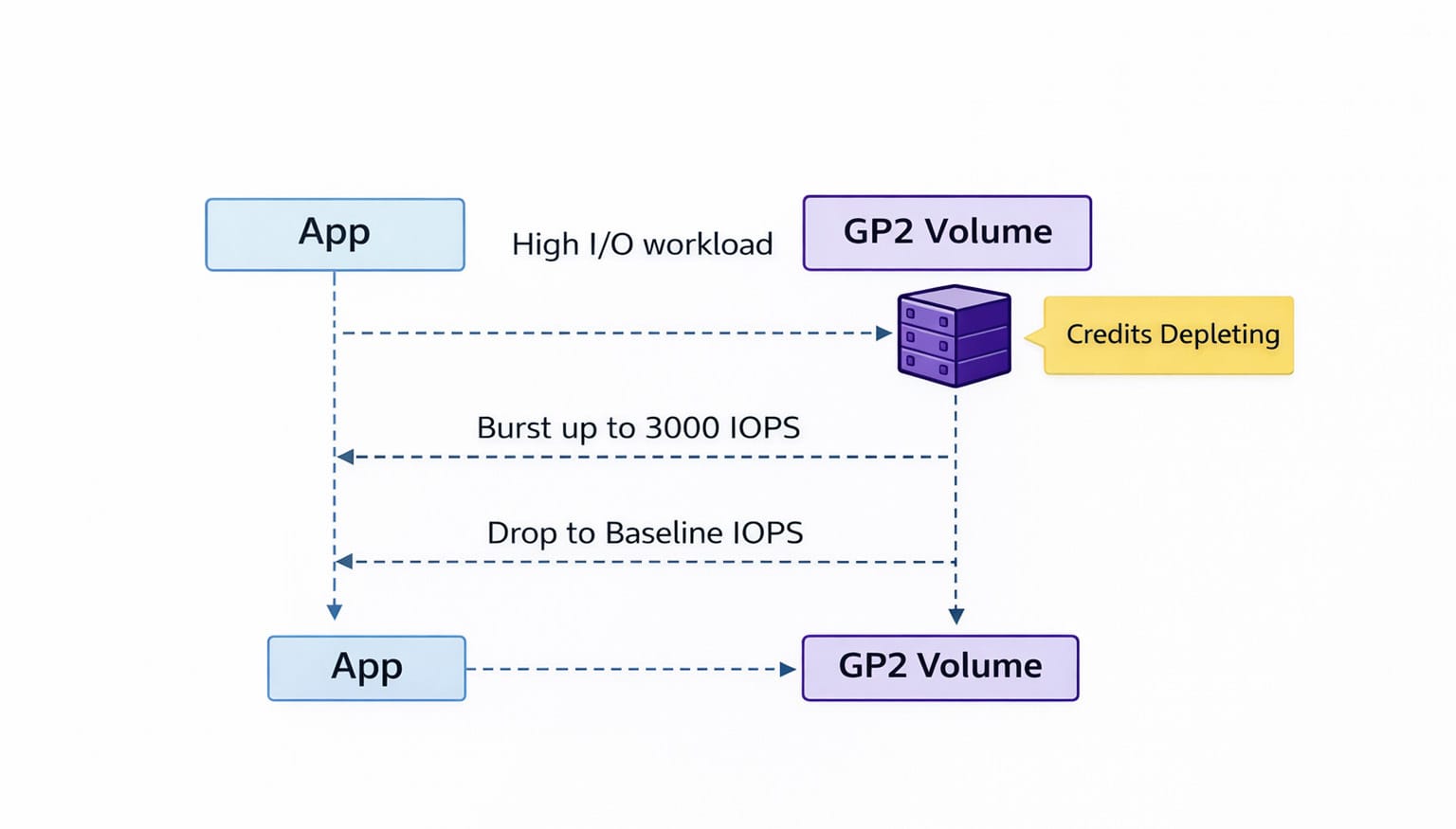
In real production systems, this is where instability appears.
Performance looks stable during short load tests.
Thirty to forty minutes into steady write pressure, latency increases and queue depth begins to rise.
In CloudWatch, this typically shows up as:
- Increasing
VolumeQueueLength - Rising
VolumeWriteLatency - Higher variability in
VolumeIdleTime
If your workload regularly operates above baseline IOPS for extended periods, GP2 introduces risk.
The issue is not peak performance.
It is sustained behavior under continuous pressure.
GP3: Decoupled Performance Architecture
GP3 removes the dependency between storage size and performance.
Every GP3 volume includes:
- 3,000 IOPS baseline
- 125 MB/s baseline throughput
You can provision up to:
- 16,000 IOPS
- 1,000 MB/s throughput
- 64 TiB storage
IOPS and throughput are explicitly configured and independent of storage capacity.
There is no credit system.
There is no burst window.
Performance is deterministic.
Architecture Comparison
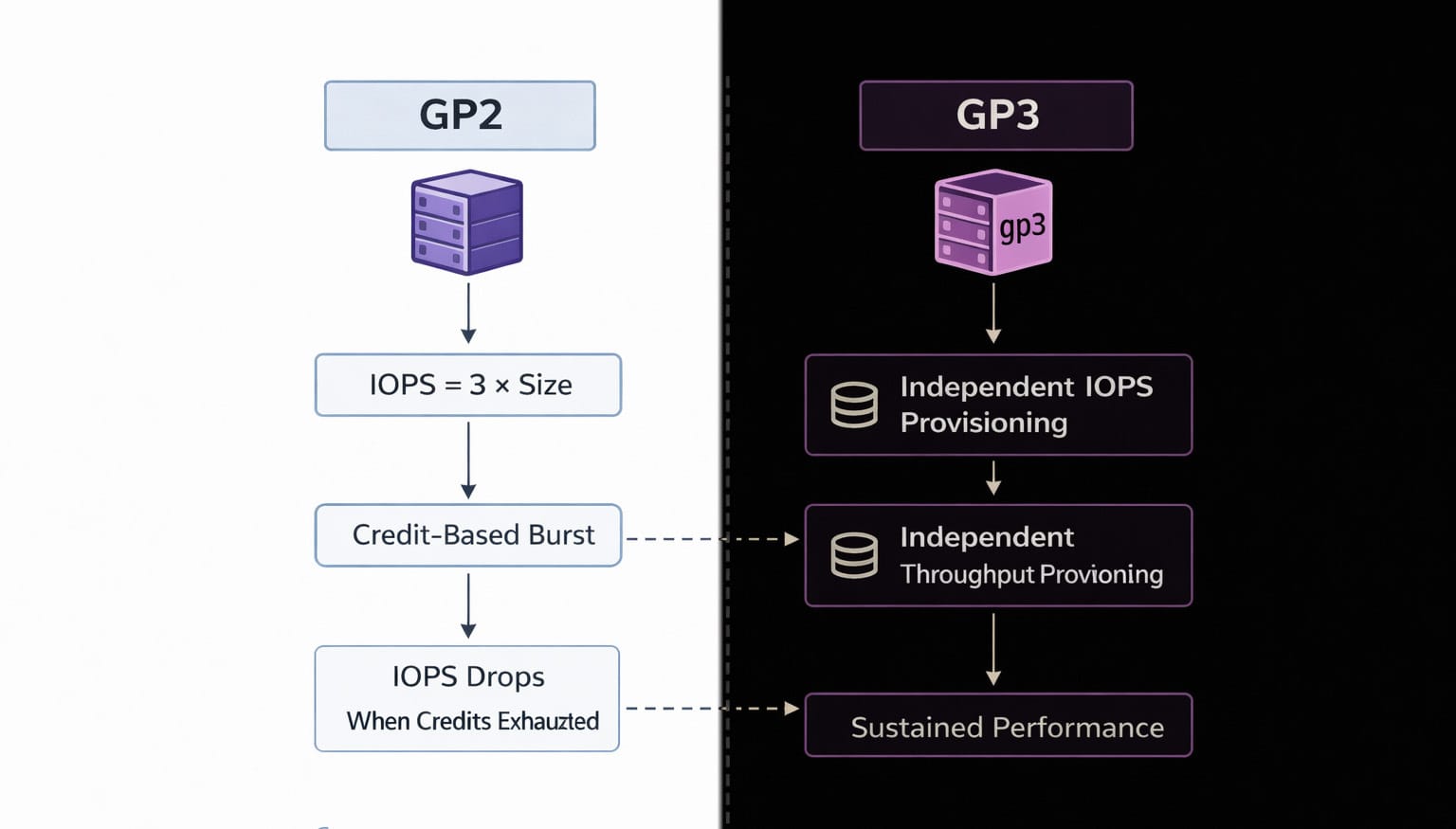
GP2 provides proportional performance tied to size.
GP3 provides provisioned performance tied to workload requirements.
That architectural difference becomes operationally significant under sustained load.
IOPS vs Throughput: Workload Sensitivity
Performance tuning requires understanding workload patterns.
- Small block workloads (4K–16K) are typically IOPS-bound.
- Large block workloads are typically throughput-bound.
GP2 scales both indirectly through volume size.
GP3 allows each dimension to be tuned explicitly.
For production databases running steady transactions, sustained IOPS consistency is often more important than theoretical burst capacity.
Sustained Workload Benchmark
Test configuration:
- 500 GB volume
- 70% write workload
- 45-minute sustained load
- Target: 6,000 IOPS
These numbers reflect typical behavior observed under sustained write-heavy workloads, not short synthetic burst tests
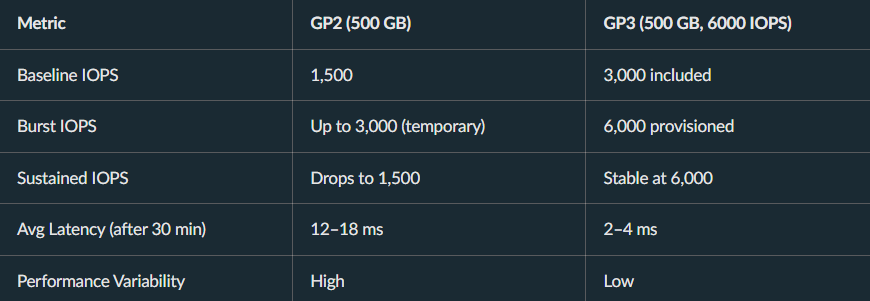
GP2 performs adequately at the beginning of the workload.
Once burst credits deplete, latency variance increases and throughput stabilizes at baseline.
GP3 maintains consistent I/O performance across the entire duration.
Consistency is what production systems require.
Real Cost Comparison
Requirement:
- 6,000 sustained IOPS
- 500 GB usable storage
GP2
To achieve 6,000 baseline IOPS:
6,000 ÷ 3 = 2,000 GB2 TB × ~$0.10 per GB ≈ ~$200/month
You are paying for capacity purely to achieve performance.
GP3
Provision:
- 500 GB storage
- 6,000 IOPS
Estimated monthly cost:
- 500 GB × ~$0.08 = ~$40
- Additional 3,000 IOPS × ~$0.005 = ~$15
- Throughput adjustment ≈ ~$5–10
Total ≈ ~$60–65/month
The cost difference is not linear. It compounds with scale across environments and accounts.
Across multiple volumes, the annual savings become material.
Operational Considerations
Migrating from GP2 to GP3 is straightforward:
aws ec2 modify-volume \
  --volume-id vol-xxxxxxxx \
  --volume-type gp3
In most cases:
- Modification is online
- No IAM changes required
- Monitoring remains identical
From an operational perspective, the change is minimal.
From a performance predictability perspective, the impact is significant.
When GP3 Should Be the Default
- Production databases
- Search and indexing systems
- Write-heavy services
- Sustained transaction workloads
- Cost optimization initiatives
GP2 remains acceptable only where legacy automation or temporary environments prevent modification.
FAQs
What is the difference between AWS GP2 and GP3?
AWS GP2 volumes tie performance to storage size and use burst credits, while GP3 volumes provide independent IOPS and throughput configuration with more predictable performance and lower costs.
Is GP3 cheaper than GP2 in AWS?
Yes. GP3 volumes are generally cheaper than GP2 because they separate storage capacity from performance. This allows you to provision only the IOPS and throughput you actually need.
Why should I migrate from GP2 to GP3?
Migrating to GP3 can reduce AWS EBS costs, improve sustained disk performance, and eliminate burst credit limitations commonly seen with GP2 volumes.
Can I migrate AWS EBS volumes from GP2 to GP3 without downtime?
Yes. AWS allows online EBS volume modification, so most GP2 to GP3 migrations can be completed without stopping EC2 instances.
aws ec2 modify-volume \
--volume-id vol-xxxxxxxx \
--volume-type gp3
When should I use GP3 volumes in AWS?
GP3 volumes are ideal for Kubernetes clusters, production databases, high-performance applications, DevOps workloads, and systems that require predictable storage performance and cost optimization.
Conclusion
GP2 volumes were designed for older AWS workloads, but modern production systems need predictable performance and better cost efficiency. GP3 removes burst credit limitations, delivers stable IOPS, and helps reduce unnecessary EBS spending. For most AWS environments today, GP3 should be the default choice for performance and cost optimization.