
On this page
VPC Endpoint vs NAT Gateway: Which AWS Networking Choice Reduces Kubernetes Costs in 2026?
Learn when to use AWS VPC Endpoints and NAT Gateways in Kubernetes environments. Compare cost, security, traffic flow, and EKS networking tradeoffs to reduce AWS infrastructure spend.

Cloud cost optimization usually starts with compute and storage. Teams review EC2 sizing, optimize Kubernetes resources, and remove unused infrastructure. Networking often receives the least attention because the cost addition brought by networking is not so intuitive.
One pattern that appears repeatedly in Kubernetes environments on AWS is that the data transfer cost adds up pretty fast. AWS bills not just the traffic sent over the internet but also the Internet usage for using AWS specific services. CloudWatch telemetry, ECR image pulls, S3 traffic, and Secrets Manager access often continue flowing through NAT infrastructure long after networking architecture should have evolved.
Operationally nothing appears broken. Applications continue serving traffic normally while AWS networking costs gradually increase underneath, which is exactly why these inefficiencies frequently survive infrastructure growth cycles.
Eventually infrastructure teams ask an important question:
Does this traffic actually need internet routing?
That question usually leads engineering teams toward comparing:
VPC Endpoint vs NAT Gateway.
Both solve networking problems.
They solve different operational problems.
Understanding where each fits becomes increasingly important as Kubernetes environments scale.
Why Engineering Teams Compare VPC Endpoint vs NAT Gateway
Engineering teams usually compare VPC Endpoint vs NAT Gateway after AWS networking costs become more visible during infrastructure growth.
Smaller Kubernetes environments rarely expose networking inefficiencies because traffic volumes remain manageable. As Kubernetes platforms scale, networking architecture begins influencing infrastructure economics more directly.
Examples include ECR image pulls, CloudWatch telemetry, S3 backup traffic, Secrets retrieval, CI/CD artifact downloads, and internal platform services. Many environments route all of this traffic through NAT Gateway because infrastructure continues functioning correctly.
The problem appears later.
Networking efficiency gradually declines while infrastructure usage continues growing.
The comparison is not really about replacing one service with another.
It is about understanding where each networking component fits operationally.
Why Kubernetes Networking Becomes Expensive Over Time
Production Kubernetes environments usually place worker nodes inside private subnets to improve security and reduce internet exposure. Internal APIs remain isolated, databases stay private, and worker nodes operate without public IP addresses. The approach improves security posture, but private infrastructure still requires outbound connectivity.
Kubernetes worker nodes routinely pull container images from ECR, send telemetry into CloudWatch, retrieve objects from S3, access Secrets Manager, and communicate with external services. Traditional architectures commonly solve these requirements through NAT Gateway because it provides outbound internet access while keeping workloads inside private networking boundaries.
Operationally, the architecture works well and scales predictably, which explains why networking assumptions often remain unchanged for long periods. The challenge usually appears later as Kubernetes environments scale and traffic patterns evolve. CloudWatch telemetry grows, ECR image pull volume increases, and S3 backup traffic expands over time while networking assumptions often remain unchanged.
NAT Gateway itself usually is not the problem. Infrastructure growth without periodic networking reviews is what gradually creates inefficiencies over time.
Infrastructure rarely becomes expensive because of one large de
How NAT Gateway Traditionally Solved This Problem
NAT Gateway exists primarily to allow resources inside private subnets to establish outbound internet connectivity without exposing infrastructure publicly.
The operational simplicity explains why teams adopt it early.
AWS handles:
- Availability
- Scaling
- Infrastructure maintenance
- Capacity management
- Operational resilience
Engineering teams deploy infrastructure.
AWS owns operational responsibility.
For larger platform teams this creates legitimate operational value. Networking failures tend to create frustrating incidents because they affect systems horizontally rather than individually. When outbound connectivity breaks unexpectedly, image pulls begin timing out, package repositories become unavailable, monitoring telemetry disappears, and troubleshooting becomes noisy quickly.
Managed infrastructure reduces operational ownership.
The tradeoff appears inside billing.
AWS NAT Gateway pricing generally includes:
- Hourly infrastructure charge
- Data processing charge
Example pricing:
$0.045/hour

+

$0.045 per GB processed
Pricing varies by region.
Infrastructure behavior remains largely consistent.
Small Kubernetes environments rarely expose inefficiencies because traffic volumes remain manageable. Larger environments eventually surface the issue as infrastructure scale changes while networking architecture remains static.
One infrastructure review I worked through involved an internal Kubernetes platform where NAT Gateway costs increased steadily over multiple quarters. Teams optimized compute and storage aggressively while networking architecture
The Hidden NAT Gateway Problem Most Teams Eventually Discover
The issue is not NAT Gateway itself.
The operational problem usually appears when NAT Gateway becomes the default networking path for AWS-native traffic that could move through AWS VPC Endpoint infrastructure instead.
Consider a common EKS environment.
Infrastructure requirements:
- Pull images from ECR
- Push logs into CloudWatch
- Read backup data from S3
- Retrieve Secrets Manager values
Traditional networking flow:
Infrastructure continues functioning correctly, but networking paths become increasingly inefficient as AWS-native traffic grows over time.
Traffic exits private networking boundaries only to re-enter AWS-managed infrastructure.
NAT processing charges continue accumulating because networking paths still depend on NAT infrastructure.
One pattern that appears repeatedly in larger EKS environments is teams aggressively optimizing compute resources while networking architecture survives untouched across multiple infrastructure growth cycles.
NAT Gateway usually is not the original problem.
Platform growth without networking review usually is.
Example NAT processing costs:
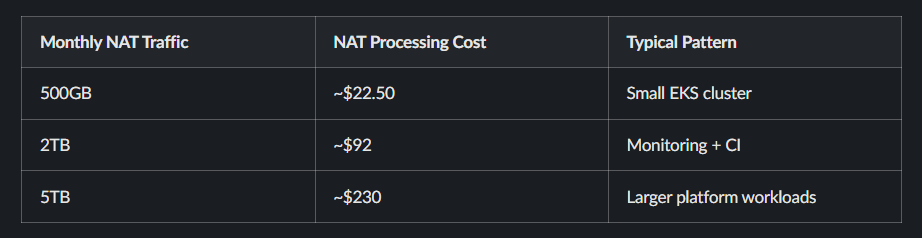
These numbers typically become visible only after infrastructure grows beyond original assumptions.
Real Cost Example: NAT Gateway vs VPC Endpoint in EKS
Suppose an EKS environment includes:
- Three worker nodes
- CloudWatch logging
- ECR image pulls
- 2TB monthly S3 backup traffic
Traditional architecture:
EKS Worker
↓

NAT Gateway
↓

S3
NAT processing estimate:
2048 × $0.045

≈ $92/month
Annual infrastructure impact:
≈ $1100/yearMoving supported AWS-native traffic through VPC Endpoint does not eliminate NAT Gateway completely.
It reduces unnecessary NAT processing dependency.
Smaller environments rarely notice immediately.
Larger Kubernetes environments eventually expose the difference.
What VPC Endpoint Changes
VPC Endpoint exists specifically to remove unnecessary internet routing paths when infrastructure communicates with supported AWS services.
Instead of sending traffic through NAT infrastructure, traffic remains entirely inside AWS networking.
Traffic remains inside AWS infrastructure, reducing NAT processing requirements and removing unnecessary internet routing dependency.
Operational improvements typically include:
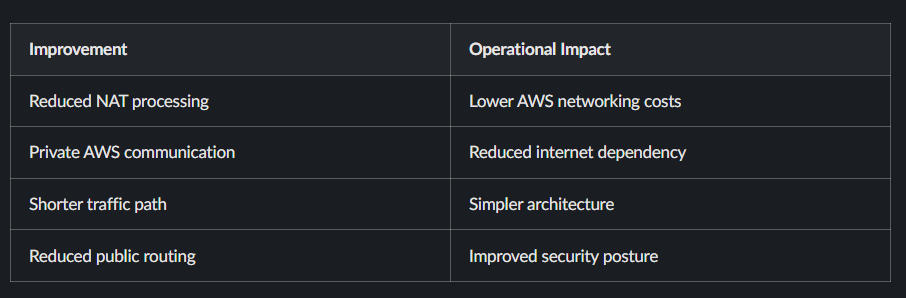
For Kubernetes environments heavily integrated with AWS-native services, these improvements become increasingly valuable as infrastructure scales.
How VPC Endpoint Works Internally
AWS VPC Endpoint creates private connectivity between your VPC and supported AWS services.
AWS provides two endpoint models.
Gateway Endpoint
Gateway Endpoints commonly support:
- S3
- DynamoDB
Traffic flows through private routing infrastructure.
Storage-heavy Kubernetes environments frequently benefit from Gateway Endpoints because S3 traffic often grows steadily alongside infrastructure.
Interface Endpoint
Interface Endpoints commonly support:
- ECR
- CloudWatch
- Secrets Manager
- Systems Manager
- KMS
AWS provisions Elastic Network Interfaces directly inside your VPC.
Infrastructure communicates privately without public internet traversal.
Operationally, mature Kubernetes environments frequently adopt both endpoint models.
How VPC Endpoint Helps AWS Cost Optimization
For Kubernetes teams focused on AWS cloud cost optimization, VPC Endpoint frequently becomes an important networking improvement because it reduces unnecessary NAT processing charges.
Examples commonly include ECR image pulls through NAT Gateway, CloudWatch telemetry through NAT Gateway, S3 traffic through NAT Gateway, and Secrets Manager access through NAT Gateway.
Individually these patterns rarely look expensive.
At infrastructure scale they become visible.
Networking optimization projects often start by reducing unnecessary NAT Gateway dependency.
Practical Configuration Example
Gateway Endpoint for S3:
resource "aws_vpc_endpoint" "s3" {

  vpc_id = aws_vpc.main.id

  service_name = "com.amazonaws.us-east-1.s3"

  vpc_endpoint_type = "Gateway"

  route_table_ids = [
    aws_route_table.private.id
  ]

}
Interface Endpoint example:
resource "aws_vpc_endpoint" "ecr" {

 vpc_id = aws_vpc.main.id

 service_name = "com.amazonaws.us-east-1.ecr.api"

 vpc_endpoint_type = "Interface"

 subnet_ids = aws_subnet.private[*].id

 security_group_ids = [
   aws_security_group.endpoint.id
 ]

}
Implementation itself is usually straightforward.
The larger challenge involves understanding where VPC Endpoint produces measurable operational value.
Migration Guidance
Teams rarely migrate networking architecture all at once.
The practical approach usually starts by identifying AWS-native traffic already flowing through NAT infrastructure.
Good first candidates include:
- S3
- CloudWatch
- ECR
Migration generally works best incrementally.
Measure traffic.
Understand NAT dependencies.
Validate networking behavior.
Reduce unnecessary routing gradually.
Networking changes deserve validation before broader rollout.
When To Use NAT Gateway vs VPC Endpoint
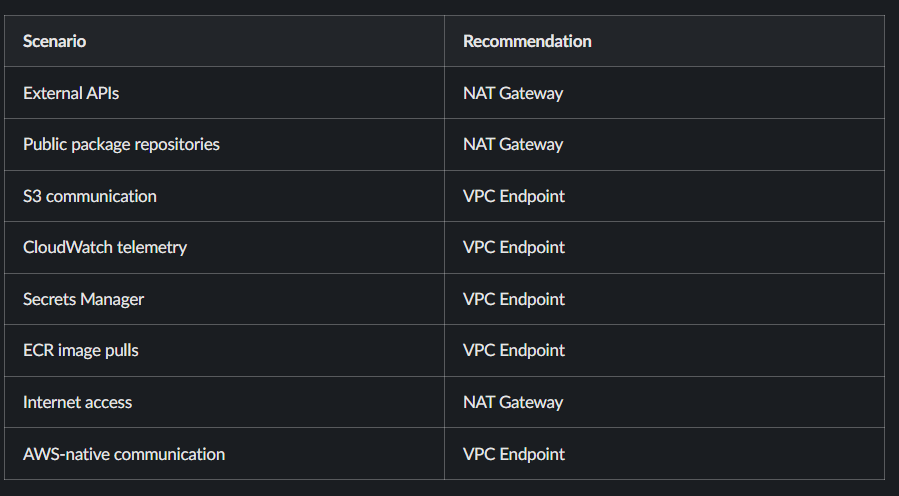
Most mature Kubernetes environments benefit from both.
The goal is not removing NAT Gateway.
The goal is reducing unnecessary NAT dependency.
What I Would Deploy Today
If I were building Kubernetes infrastructure today, NAT Gateway and VPC Endpoint would exist together from the beginning.
NAT Gateway still matters because internet connectivity requirements do not disappear. External APIs, package repositories, third-party integrations, and public internet communication still require outbound routing.
AWS-native traffic increasingly belongs inside AWS-native networking paths.
One infrastructure pattern that appears repeatedly in growing environments is networking architecture surviving unchanged while infrastructure scale changes dramatically. Compute infrastructure changes over time, storage requirements evolve, and platform behavior shifts as environments grow.
Networking architecture deserves the same review cycle because assumptions that made sense several years ago may no longer align with how infrastructure behaves today.
Frequently Asked Questions
Does VPC Endpoint replace NAT Gateway?
No. NAT Gateway and VPC Endpoint solve different networking problems. NAT Gateway handles outbound internet connectivity. VPC Endpoint creates private connectivity between your VPC and supported AWS services.
Does Kubernetes require NAT Gateway?
Not always. Kubernetes workloads often require outbound internet connectivity, but AWS-native service communication can frequently move through VPC Endpoint infrastructure instead.
Does VPC Endpoint reduce NAT Gateway cost?
Yes. AWS VPC Endpoint can reduce NAT processing charges by removing unnecessary NAT dependency for supported AWS services.
Which is better for EKS: NAT Gateway or VPC Endpoint?
Most mature EKS environments benefit from both. NAT Gateway handles internet connectivity. VPC Endpoint improves AWS-native service communication.
Gateway Endpoint vs Interface Endpoint: Which should I use?
Gateway Endpoints commonly support S3 and DynamoDB. Interface Endpoints support services like ECR, CloudWatch, Secrets Manager, and Systems Manager.
Does VPC Endpoint improve AWS networking security?
Yes. VPC Endpoint keeps supported AWS service communication inside AWS infrastructure, reducing internet routing dependency and improving networking isolation.
Conclusion
VPC Endpoint does not replace NAT Gateway, and NAT Gateway does not eliminate the need for VPC Endpoint. The two services solve different networking problems, which is why most mature Kubernetes environments eventually benefit from using both together.
NAT Gateway remains important for outbound internet access, external APIs, package repositories, and third-party integrations. VPC Endpoint becomes valuable when AWS-native traffic such as CloudWatch telemetry, ECR image pulls, Secrets Manager access, and S3 communication no longer need unnecessary internet routing.
One pattern appears repeatedly as Kubernetes platforms grow: compute resources get optimized, storage gets reviewed, but networking assumptions often survive unchanged for years. The original architecture may still work operationally while becoming less efficient as infrastructure scales.
Infrastructure costs rarely increase because of one large decision. More often, costs grow from smaller assumptions that survive longer than expected.
Networking architecture is usually one of them.
Read More
- Still Paying High AWS Bills? Avoid NAT Gateway with VPC Endpoints
Learn how AWS VPC Endpoints reduce NAT Gateway charges, improve security posture, and optimize AWS networking costs.
https://www.kubeblogs.com/reduce-cost-and-improve-security-with-amazon-vpc-endpoints/ - Your Kubernetes API Is Public — Here’s How to Make It Private
Learn how to secure Kubernetes API access using private networking and identity-based access controls.
https://www.kubeblogs.com/your-kubernetes-api-is-public-heres-how-to-make-it-private/ - The Simplest AWS Security Hack I've Shipped in a Decade
Practical AWS networking and outbound traffic security improvements using Route 53 DNS Firewall.
https://www.kubeblogs.com/the-simplest-aws-security-hack-ive-shipped-in-a-decade/ - AWS Charges Extra for Storage Performance That Civo Ships by Default
AWS cost optimization breakdown and infrastructure efficiency comparison.
https://www.kubeblogs.com/aws-charges-extra-for-storage-performance-that-civo-ships-by-default/