
On this page
K3s vs Kubernetes (K8s): Performance, Architecture, Use Cases and When to Choose Each
K3s vs Kubernetes (K8s) comparison with architecture, performance, and use cases. Find the right choice for DevOps, edge, and production.

K3s and Kubernetes (K8s) are often compared, but they are not direct competitors. They solve different infrastructure problems.
K3s can run in under 200MB of RAM, while a standard Kubernetes cluster can exceed 800MB. This makes the choice highly dependent on your environment and workload.
This guide explains the key differences between K3s and Kubernetes, focusing on architecture, performance, and real-world DevOps use cases.
What is Kubernetes (K8s)
Kubernetes is a container orchestration platform designed to manage large-scale distributed systems.
It provides:
- Automated deployment and scaling
- Self-healing infrastructure
- Service discovery and load balancing
Kubernetes is widely used in production environments where scalability and reliability are critical.
What is K3s
K3s is a lightweight Kubernetes distribution designed for environments with limited resources.
It simplifies Kubernetes by:
- Packaging components into a single binary
- Using lightweight storage (SQLite by default)
- Reducing operational complexity
K3s is commonly used in edge computing, IoT, and development environments.
K3s vs Kubernetes: Key Differences
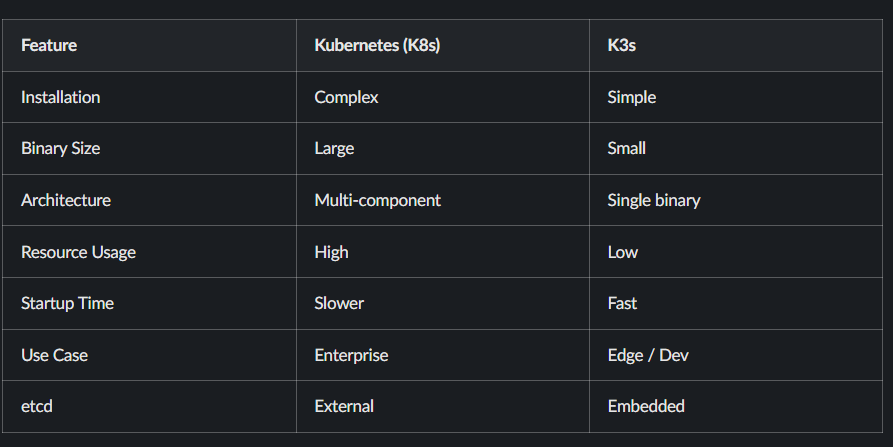
K3s vs Kubernetes Architecture Comparison

K3s vs Kubernetes Performance Comparison
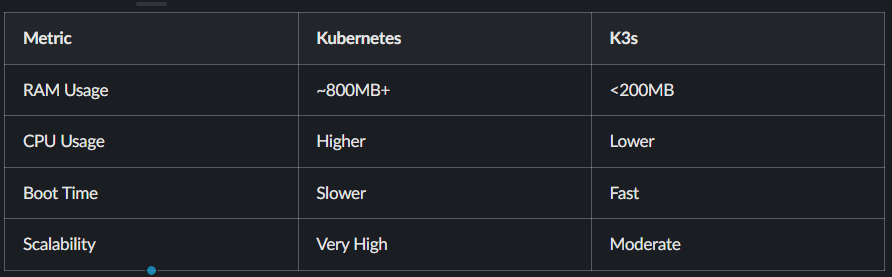
From practical testing, K3s consistently performs better on small instances (1–2GB RAM), while Kubernetes starts showing its strength as workload complexity and scale increase.
Real-World Observation
In a test cluster:
- K3s used approximately 200MB RAM
- Kubernetes used more than 800MB RAM
K3s performs better in constrained environments, while Kubernetes handles high-scale workloads more effectively.
K3s vs Kubernetes Use Cases
When to Use K3s
- Edge computing
- IoT deployments
- CI/CD environments
- Local development
When to Use Kubernetes
- Production systems
- Microservices architecture
- Multi-cloud deployments
- High-traffic applications
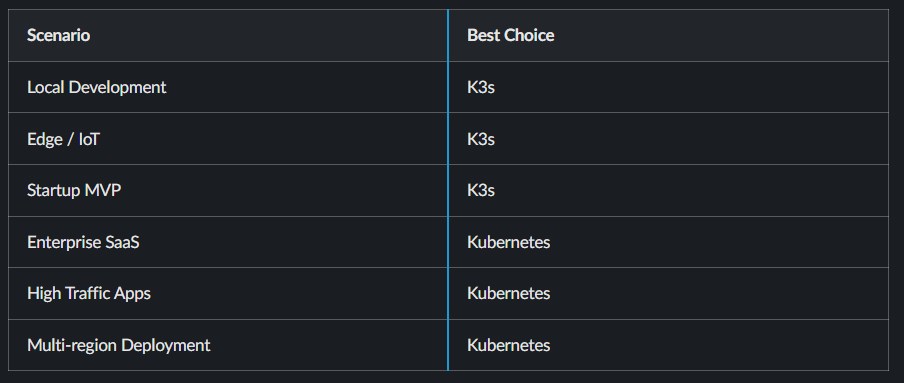
A common mistake is adopting full Kubernetes too early. For many small projects or internal tools, K3s can handle the workload with significantly less operational overhead.
Decision Guide
Installation Examples
K3s Installation
curl -sfL https://get.k3s.io | sh -Kubernetes Installation (kubeadm)
kubeadm initPros and Cons
K3s
Pros
- Lightweight
- Fast setup
- Low resource usage
Cons
- Limited scalability
- Fewer enterprise features
Kubernetes
Pros
- Highly scalable
- Rich ecosystem
- Production-grade
Cons
- Complex setup
- Higher resource usage
FAQ
Is K3s production ready
K3s is production ready for lightweight workloads, especially in edge and constrained environments.
Is K3s faster than Kubernetes
K3s has faster startup time and lower resource consumption compared to standard Kubernetes.
Can K3s replace Kubernetes
K3s is not a replacement for Kubernetes in enterprise environments. It is designed for specific use cases like edge and development.
Read More (Kubeblogs)
Continue learning with these in-depth guides:
- Kubernetes Architecture Deep Dive (Components Explained)
https://www.kubeblogs.com/kubernetes-architecture-explained - K8s vs Docker: Complete Comparison Guide
https://www.kubeblogs.com/k8s-vs-docker - Best Kubernetes Monitoring Tools for DevOps
https://www.kubeblogs.com/kubernetes-monitoring-tools
Conclusion
There is no one-size-fits-all choice here, but in most early-stage or resource-constrained setups, K3s is often the more practical starting point.
K3s and Kubernetes are designed for different types of environments, and choosing the right one depends on your specific use case.
K3s is ideal for lightweight workloads, edge computing, and development environments where simplicity and low resource usage are important.
Kubernetes, on the other hand, is built for large-scale, production-grade systems that require high availability, scalability, and a mature ecosystem.
In most modern DevOps workflows, both are used together:
- K3s for development, testing, and edge deployments
- Kubernetes for production and high-scale applications
Selecting the right platform is less about features and more about aligning with your infrastructure needs and long-term scalability goals.